Showing posts with label Protests. Show all posts

Monday, 19 March 2012

Costuming of AIM protests

AIM (American Indian Movement) has been around since the 1968 when it was first founded and so it has gone through a wide variety of styles of protests and costuming.


In the photo of the 1968 American Indian Movement protest there are several people wearing outfits with traditional tasseling or beading as though to visually point out that the traditional culture is still very alive. In this photo you see that it does seem a peaceful march and one can even see that there are young children marching with the adults. The large sign being held up could have been the predecessor to their symbol today(the black, yellow, white and red flag)
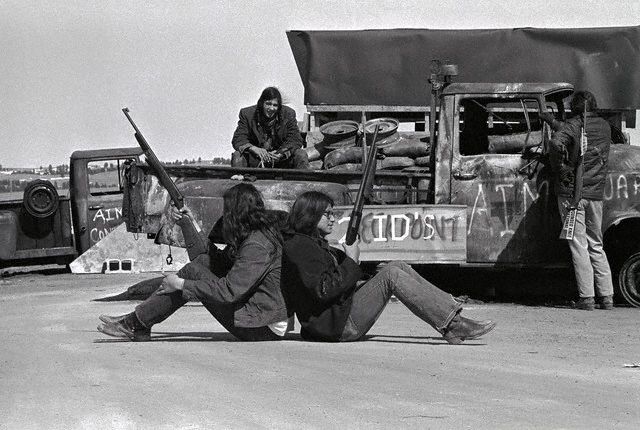
Armed Native Americans Man Roadblock
Armed AIM Roadblock courtesy of Soldiers For The Cause


1992 Anti-Columbus Day Protest
That being AIM has also had violent direct actions for example armed roadblocks as well. In this photo we can clearly see that these individuals associate themselves with AIM and have even spay painted it on the side of the vehicle. In this case though, there are no children, only men and guns.


This is a protest against Columbus Day because some people feel that it is improper to have a holiday in the name of a settler and feel that it does a diservice to their ancestors who died in conflicts against the settlers. I would like to point out that the foremost banner is from AIM however to the far left there is a darker banner that appears to have writing that appears to be of asian origin on it. This is one thing I noticed about AIM; they often have other groups protesting with them or they protest with other groups.


American Indian movement activist Glenn Morris is arrested during protests to halt the annual Columbus Day Parade in 2007 in Denver. (AP photo)
"American Indian movement activist Glenn Morris
 is arrested during protests to halt the annual
 Columbus Day Parade in 2007 in Denver." 
Courtesy of The Buffalo Post

This is Glenn Morris one of the leaders of AIM being arrested during the annual repeat of the march seen above. I would like to point out the use of AIM's colours on his clothing in a fashion that is similar to clothing that you might see in an aboriginal history museum. I would point out what red may represent but I mentioned it in my last post. However, I did want to add that in the archaeological record, many native cultures used red ochre in their burials and sacred places so the colour red has had a strong meaning and value in the native cultures for many years.

In many Native protests there is someone dressed in traditional style clothing or clothing that follows some part of the traditional clothing style. I believe that this is meant to be a visual representation of the enduring power of native cultures. It tells the viewers of the protest that the traditional culture is still alive today and that there are people who are proud to be Native, Indian, Cree, Blackfoot, James Bay Cree, status or not, however they chose to identify themselves. It sends the same message as the image said in my first post: We Shall Remain.

Another use of a tradition in protest is the use of drumming which is often accompanied by singing and dancing. The amount of noise that just ten drummers can make would be enough for protesters to draw attention to their cause but imagine over a hundred dancer, singers, and drummers.


Occupy Denver-Native American Glenn Morris, AIM-Colorado
"Glenn Morris, a leader of the American Indian Movement
 of Colorado (AIM) addressing Occupy Denver October 22"2011.
 Courtesy of Carol Berry

This is another photo of Glenn Morris speaking to the Occupy Movement in Denver. In the foreground right we see a young woman and in this case, all of the individuals are wearing modern style casual clothes.


In comparison with the last photo, this photo seems to have a very different feel to it. In the foreground we see the AIM flag but instead of the casually-clad people in the last photo the flag is hoisted by people wearing almost militant gear. This row looks more like a row of flag bearers preparing for a battle than the young children we saw in the first image. I would also like to point out that the third flag down the row is the Red Power United flag whom I talked about in my last post as being a more violent direst action group.


Overall, I would saw that AIM does not have as standard a costume as some other groups may nor do they have a standard style but their adaptability may be what has made their group so popular.

Wednesday, 7 March 2012

What is a social movement?

What is a social movement is not a simple question. It still does not have a solid definition yet and probably never will because the point of a social movement is to change the status quo of thinking.


A social movement is often confused with protests. A visual explanation is:


Picture-8-800x500
This is a protest that took place in Toronto.
Occupy Denver-Native American Glenn Morris, AIM-Colorado
A photo of a the leader of American Indian Movement(AIM, a group that we will talk about in a later post) addressing Occupy Denver
Both of these photos are; in fact, protests under the same social movement. Looking at the photos you can even see that protests, that may share many of the same basic ideas and movements, can be highly varied in their costumes(what they wear while protesting) and their slogans/signs.
Basically what I am saying is that social movement is the umbrella that covers a wide style and size of protests(Young-Leslie). 


In the NSM(Native Sovereignty movement) case, the social movement is about about Native rights, particularly the right to self-govern. Meanwhile, protests are the events that people do to increase awareness of their cause.


Allow me to pause for a moment to cover a few terms that I just used. First of all, what is meant by Native in this context. This is another looks-simple-but-is-not question.
First of all, the government declares "Indian Status" as "being registered under the Indian Act is referred to as a Registered Indian"(http://www.aadnc-aandc.gc.ca/eng/1100100032374). 
<<As a quick aside, many of the government documents use the term Indian to describe what we now refer to as Natives or aboriginals. >>
So what is the criteria for registering under the Indian Act?
Here is the criteria found on this government site:

  1. "You were entitled to registration prior to the changing of the Indian Act on April 17, 1985
  2. You lost your Indian Status as a result of your marriage to a non-Indian man (s. 12(1)(b)), including enfranchisement upon your marriage to a non-Indian man (s. 109(2));
  3. Your mother and father's mother did not have status under the Indian Act, before their marriage and you lost your status at the age of 21 (s.12 (1)(a)(iv) – referred to commonly as the double-mother rule);
  4. Your registration was successfully protested on the grounds that your father did not have status under the Indian Act, however your mother had status;
  5. You lost your registration because you or your parents applied to give up registration and First Nation membership through the process known as "enfranchisement"; or
  6. You are a child of persons listed in 1 to 5 above"
So the government has very set ideas of what makes you a Status Native but there is also Non-Status Native which is often defined as “people who identify themselves as Indians but who are not entitled to registration on the Indian Register pursuant to the Indian Act" (AADNC definition)

When one look at these two definitions, one can see that there could be point of contention: Status is defined by a the Canadian government so an individual's level of inclusion in a group is defined by a governing power rather than themselves. Especially when there is individuals of this group that feel their identity should not be controlled by this faction, reasons are beginning to become apparent for why there would be protest about their right to sovereignty including their right to define themselves.


Yelvington has the idea that ethnicity is defined by the other:
 'Ethnicity is an aspect of social relationship between 
agents who consider themselves as being culturally 
distinctive from members of other groups with 
whom they have a minimum of regular interaction. 
It can thus also be defined as a social identity based 
on a contrast to others, characterised by 
metaphoric or fictive kinship' (Yelvington, 1991: 
168)
This means that the ethnic grouping of Native had to be defined by having non-Natives(Young-Leslie). This also brings up the fact that the term Native takes many varied groups of peoples, all of whom have varied traditions and cultures from the others, and lumping them all together. Oddly enough, I would argue that without this lumping ethnic term the Native sovereignty movement would not be able to exist. The term Native allowed groups that would not have defined themselves as allies to band together against a 'common enemy' (often the government or anti-native right groups). I will talk more about how this alliance created the movement in my next blog.


In my next blog, I will discuss the definition of sovereignty and history of this movement and the factors behind it.

Works Cited:
AADNC. Electronic source. http://www.aadnc-aandc.gc.ca/eng/1100100014433/1100100014437

Dr. Young-Leslie, Heather. Lecture slides. March 5th "Ethnicity".
Dr. Young-Leslie, Heather. Lecture slides. January 23rd "Social Movements".
Yelvington Kevin A. 
  1991 Ethnicity as Practice? A Comment on Bentley. Comparative Studies in Society and History, Volume 33(1):158-168
Aborignial affairs and Northern Development Canada. Electronic source. http://www.aadnc-aandc.gc.ca/eng/1100100032472